
Your current browser version is too low, in order to bring you a better browsing effect, please use a higher version browser

Home > product > Polycrystalline silicon solar panels
Polycrystalline silicon solar panels
Product Features:
Like other solar cells, polycrystalline silicon solar panels work based on the photoelectric effect. When sunlight shines on the polycrystalline silicon semiconductor material on the panel, the photons excite the electrons in the semiconductor, causing them to jump from the valence band to the conduction band, generating electron-hole pairs. These electrons and holes move to the two poles respectively under the action of the electric field inside the semiconductor, forming an electric current, thereby realizing the conversion of solar energy into electrical energy.
Brief introduction

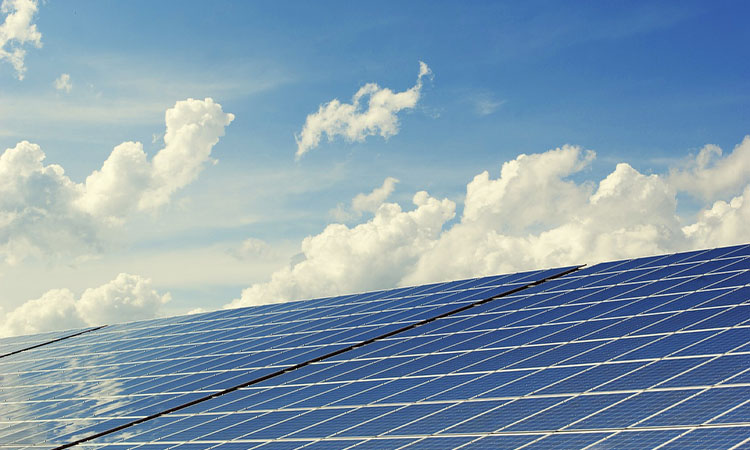
Polycrystalline silicon solar panels are photovoltaic components composed of polycrystalline silicon solar cells.

Theory

Relatively low cost: Compared with monocrystalline silicon solar panels, the manufacturing cost of polycrystalline silicon is lower. This is because the production process of polycrystalline silicon is relatively simple, and it does not require high purification and fine processing of silicon materials like monocrystalline silicon. Therefore, in large-scale applications, polycrystalline silicon solar panels have a higher cost performance.
Moderate conversion efficiency: The photoelectric conversion efficiency of polycrystalline silicon solar panels is generally around 12%-18%, which is lower than that of monocrystalline silicon solar panels, but can still meet the needs of most application scenarios

Flow chart

Cell: It is the core power generation element, made of polycrystalline silicon material. Multiple cells are connected together through a specific process to form a battery assembly.
Tempered glass: As the outermost layer of the battery panel, it has the function of protecting the power generation body. At the same time, it needs to have good light transmittance. Usually, ultra-white tempered glass with a transmittance of more than 91% is selected.
EVA: Ethylene-vinyl acetate copolymer, mainly used to bond and fix tempered glass and power generation body. High-quality EVA has high light transmittance and anti-aging ability, which has an important impact on the service life of the component.
Backplane: It mainly plays the role of sealing, insulation and waterproofing. Commonly used backplane materials include TPT (polyvinyl fluoride composite film) and TPE (thermoplastic elastomer), etc., which must have anti-aging properties to ensure the warranty period of the component.

Specification parameter
Product Code Product Name Filtration Accuracy (μm) Flow Rate (m³/h) Working Pressure (MPa) Material Connection Method Dimensions (mm)
P001 Air Filter 0.1 – 10 10 – 1000 0.1 – 1.0 Stainless Steel, Fiberglass Threaded Connection, Flange Connection 200×100×300
P002 Liquid Filter 1 – 100 5 – 500 0.2 – 0.8 Stainless Steel, Polypropylene Quick Connector, Flange Connection 300×150×400
P003 Oil Filter 5 – 50 3 – 300 0.3 – 0.6 Stainless Steel, Paper Filter Element Threaded Connection, Flange Connection 250×120×350
P004 Water Filter 0.5 – 50 8 – 800 0.1 – 0.6 Stainless Steel, Ceramic Filter Element Flange Connection, Clamp Connection 350×180×450
Display of components of horizontal vacuum filter

Remote areas

Field work


Outdoor facilities

Leave a Message

If you are interested in any product, please contact us. We will introduce our products to you in more detail